
NEWS
WhatsApp Lets Parents Lock Teen Groups Behind a PIN
WhatsApp will let parents PIN-lock teen groups and Meta AI while chats stay encrypted, a lighter add-on than Instagram’s new time caps.

WhatsApp will let parents lock teen privacy settings behind a PIN and get alerts when a group hits 30, 100, or 250 members. The company announced the optional tools on September 30, 2026, and said personal messages and calls stay end-to-end encrypted, with no one outside the chat able to read or hear them.
The kit sits on teen accounts that already have Channels, Status and Meta AI, a step past the under-13 product WhatsApp launched in March, which is limited to messaging and calling. Parents can switch the whole overlay off.
Group Alerts Fire at 30, 100, or 250
The useful tripwire is not a transcript. It is a headcount. Parents can ask to be told when a teen joins a group, leaves one, or when a group they already sit in grows to 30, 100, or 250 members.
A class chat can start as a handful of saved contacts and swell once an invite link moves through a grade. The parent still cannot open the thread. They get a size flag, and that is the point of the design.
THE PARENT DASHBOARD
| Setting | What a parent can do | What stays sealed |
|---|---|---|
| Groups | Alerts on join, leave, and growth to 30, 100, or 250 members; who may add the teen | The words and calls inside the group |
| Profile photo | Who can see it | The teen’s private chats |
| Status | Whose updates the teen sees, and who sees theirs | One-to-one message text |
| Channels | How the teen uses broadcast channels | Personal calls |
| Meta AI | Default 13+ or Limited Content | End-to-end encrypted human chats |
WhatsApp put that line in public the same day, in lowercase, and kept the encryption promise in the same breath.
coming soon: optional parental controls for teen on WhatsApp. parents can help manage privacy settings, get alerts about group activity, and decide how their teen uses Meta AI, Channels and Status. messages stay end-to-end encrypted.
— WhatsApp (@WhatsApp) September 30, 2026
Optional is doing a lot of work in that post. A family that never pairs accounts, never sets a PIN and never turns on group alerts is looking at the same teen WhatsApp they had in August.
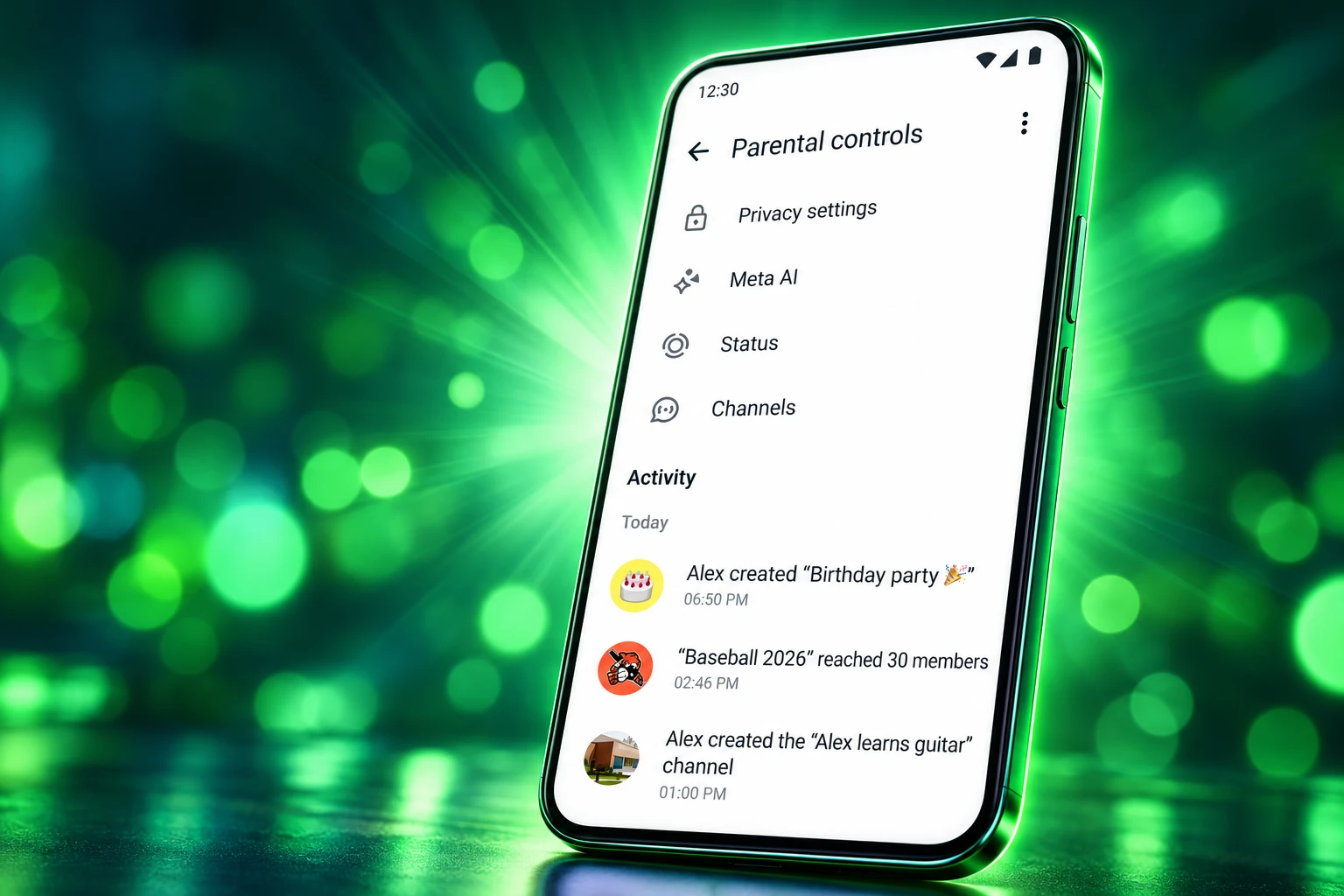
The Six-Digit PIN Parents Set Once
On parent-managed accounts, WhatsApp already makes the parent create a unique 6-digit PIN before the controls will open. The Help Center says that PIN is what stops someone else from changing the account, and a parent can change it later from their own phone under Settings, then Parental controls.
The teen overlay uses the same idea. If a teen wants to loosen who can add them to groups, who can see a profile photo, or how Channels and Status work, they need the parent’s PIN. The parent can also kill the controls entirely.
That is a household product, not a network-wide age gate. It only binds the accounts a parent actually sets up, on devices that still have to sit in the same family in the first place. A 16-year-old with a prepaid SIM and no linked parent gets none of it.
WhatsApp says the tools are meant to be set up by parents and teens together. The company also says they are “straightforward to set up,” which is true only if both phones are in the room and someone is willing to hold the PIN.
What the New Teen Controls Cover
The teen package is a short list of levers on public-facing pieces of the app, plus Meta AI. It is not a screen-time clock, and it is not a chat reader.
WHAT A PARENT CAN LOCK
- Profile photo: Parents choose who can see the teen’s picture, and a later change needs the PIN.
- Group adds: Parents choose who can add the teen to groups.
- Group alerts: Parents can get a ping on joins, leaves, and growth to 30, 100, or 250 members.
- Channels: Parents set how the teen uses Channels, the one-to-many feeds from public figures and organisations.
- Status: Parents choose whose Status the teen can see, and who can see the teen’s own updates.
- Meta AI: Parents leave the default 13+ setting or switch on Limited Content.
Help Center pages for the younger product still warn that parent-managed accounts are rolling out gradually and may not be in every region. The teen announcement did not name a country-by-country calendar either. WhatsApp’s own post still says coming soon.
A Birthday Cliff at Age 13
The teen kit is a reply to a hole WhatsApp cut itself in the spring. On March 11, 2026, the company began parent-managed accounts limited to messaging and calling, built for children under 13 after parents asked for a way to reach kids on phones they had already bought.
Those accounts are a different product. Setup needs both phones side by side and a QR link. By default, only saved contacts can message or call. Parents decide who can contact the account and which groups it can join, and they can review message requests from unknown numbers. Ads are off.
The locked-down list is long. Parent-managed accounts cannot use Meta AI, Channels, Status, Chat Lock, App Lock, linked devices, location sharing, view-once messages, or disappearing messages in individual chats. All of that is the point of an under-13 account: a small pipe, watched at the edge, with the messages still encrypted.
THE ROAD TO TEEN CONTROLS
- March 11, 2026: WhatsApp launches parent-managed accounts for pre-teens, limited to messaging and calling, gated by a 6-digit parent PIN.
- August 26, 2026: Washington Attorney General Nick Brown announces a $17.1 billion multistate deal that puts time caps and night blocks on Instagram and Facebook, not on WhatsApp.
- September 30, 2026: WhatsApp announces optional parental controls for teen accounts, with group alerts at 30, 100, or 250 members and a Limited Content switch for Meta AI.
The Help Center is blunt about what happens when that younger account ages up. Parents get a notification as the child reaches 13, or whatever higher minimum a country sets, and then the account is supposed to transition out of a parent-managed account. At that point the child gets Channels, Status and Meta AI, privacy settings revert to ordinary defaults, and parental controls on the parent’s phone, including activity alerts, go away.
September’s teen tools are how WhatsApp tries to fill that birthday. They are lighter than the pre-teen lockbox, they are optional, and they still refuse to open the messages. They also arrive on the other side of a legal fight that never named this app.
The August Deal Never Touched WhatsApp
Five weeks before the teen PIN, Meta closed a child-safety case that rewrote Instagram and Facebook for users aged 13 to 17. Washington Attorney General Nick Brown’s office called it a landmark $17.1 billion multistate settlement and listed child-safety reforms on Instagram and Facebook. WhatsApp does not appear in that list.
Let me say to the young people of Washington state: This agreement shows that your health and safety is more important than Meta’s profits.
Nick Brown, Washington Attorney General, Aug. 26, 2026 news release
The product terms are a clock. Instagram and Facebook together get a default two-hour daily cap for children, with mandatory pauses after 15 minutes of continuous use and again at 60 and 90 minutes. Nighttime blocks cut access from 12 a.m. to 6 a.m. Push notifications are supposed to drop out on weekdays from 8 a.m. to 3 p.m. during the school year.
WHAT THE AUGUST DEAL CHANGED
- The money: Brown’s office put the Meta payment at $17.1 billion, which it called the largest state consumer protection settlement outside the 1990s tobacco deals.
- The clock: A combined two-hour daily limit on Instagram and Facebook, in force for five years, with pauses at 15, 60 and 90 minutes.
- The night cut: Access blocked from 12 a.m. to 6 a.m., plus a school-year mute on weekday notifications from 8 a.m. to 3 p.m.
- The tighter cap: If Snapchat, TikTok and YouTube take comparable terms, the daily limit on each platform drops to 60 minutes for 10 years.
Those caps are about feeds, likes, beauty filters and the hours a teen can scroll. WhatsApp’s teen update is about who can add you to a group and whether Meta AI will stay chatty. A parent who walked out of August thinking Meta had put a timer on every app in the house will not find that timer here.
The split is not an accident of timing. WhatsApp’s brand is the sealed chat. Instagram’s brand, in the states’ telling, was the addictive feed. The company can give parents a map of groups without handing them a key to the vault, and it can keep saying no one, including WhatsApp, can see the messages.
Turn Off Incognito Chat for Meta AI
Meta AI is the piece of teen WhatsApp that most resembles a feed. It is an optional assistant inside the app, and parents now get two rungs. The default is a 13+ setting. The stricter rung is Limited Content.
Limited Content turns off Private Processing features such as incognito chat and message summaries. WhatsApp also says it further restricts the topics a teen can take to the bot. That is the closest the update comes to a content rating, and it still does not touch a human-to-human thread.
For families, the practical question is whether a teen uses Meta AI as a search box, a homework shortcut or a private diary that happens to sit next to the group chats. Limited Content is a way to shrink that diary. It is not a way to read the football group.
All of these controls are designed to support open conversations about WhatsApp between parents and teens, not to monitor their chats.
WhatsApp, September 30, 2026 announcement
The company added that this is “just the start,” and that it will build the controls in steps from what families say they need. That sentence leaves room for more alerts later. It also leaves room for a long stretch where the only extra thing a parent gets is a PIN and a group-size ping.
The Controls Stay Optional and Easy to Kill
People who wanted a hard age check will treat a parent PIN as a shrug. A household that never opts in is unchanged. A teen who wants a large, loosely invited group can still find one on another app the moment WhatsApp starts pinging home at 250 members. The design assumes a parent who is already in the room, holding both phones, and willing to keep the PIN.
Privacy and parental control can share one account if the company never opens the messages, and that is the bargain WhatsApp is selling. The louder objection is not that parents can see too much. It is that an optional overlay, on an app the August deal never timed, asks families to do the work regulators just forced onto Instagram’s clock.
WHAT WE KNOW
- The date: WhatsApp announced the teen controls on September 30, 2026, and its own account still labels them coming soon.
- The line: Messages and calls stay end-to-end encrypted, and parents do not get the text.
- The tripwire: Group alerts can fire on joins, leaves, and growth to 30, 100, or 250 members.
WHAT IS UNCONFIRMED
- Country dates: WhatsApp has not published a market-by-market switch-on calendar for the teen overlay.
- How pairing works: The company has not, in the materials it posted, spelled out every step for linking a teen account the way it did for under-13 setup.
Parents can still turn the controls off. Until a family sets the 6-digit PIN, teen WhatsApp is the same sealed inbox it was before September 30, with Channels, Status and Meta AI still on the home screen and no timer from the Instagram deal running in the background.

Margaret Hamilton Dies at 90 With Her Prevention Fight Unfinished

Texas Executes Jamaal Howard After Tennessee’s Failed Injection

The Next Kia Sportage Leaves Its Cheap Compact Formula

Alaska Airlines Builds the Costly Long-Haul Model It Undercut

OpenAI Agents Probe Census and Education Sites for Public Data

Alfalfa Sprouts Outbreak Follows 16 Months Without Reinspection

Instagram First Draft Pulls the Rough Cut In-House

Himalayan Glacial Flood Risk Outran Nepal’s Lake Maps

Rene Haas Ties an AI Cancer Cure to Scarce Chips

AI Influencer Labels Fail to Protect Body Image
-
 LIFESTYLE2 months ago
Alfalfa Sprouts Outbreak Follows 16 Months Without Reinspection
-
 NEWS2 months ago
Instagram First Draft Pulls the Rough Cut In-House
-
 NEWS2 months ago
Himalayan Glacial Flood Risk Outran Nepal’s Lake Maps
-
 NEWS2 months ago
Rene Haas Ties an AI Cancer Cure to Scarce Chips
-
 NEWS2 months ago
AI Influencer Labels Fail to Protect Body Image
-

 NEWS1 month ago
As Kids Get Better at Faces, Angry Women Get Harder
-

 NEWS2 months ago
NSA Wants AI to Sift Intercepts It Cannot Finish
-

 BUSINESS2 months ago
The H100 Rental Spike Nvidia Cited Has Already Faded