
NEWS
Margaret Hamilton Dies at 90 With Her Prevention Fight Unfinished
MIT confirmed Margaret Hamilton died on Sept. 30 at 90. The 1202 save is famous; her later campaign to design bugs out of code never became the industry method.

Margaret Hamilton, the MIT software lead whose code kept Apollo 11 landing through a 1202 alarm, died on Sept. 30 at 90. The institute published the notice on Oct. 7 and did not give a cause. Her daughter, Lauren Hamilton, confirmed she died in a hospital in Cambridge, Massachusetts.
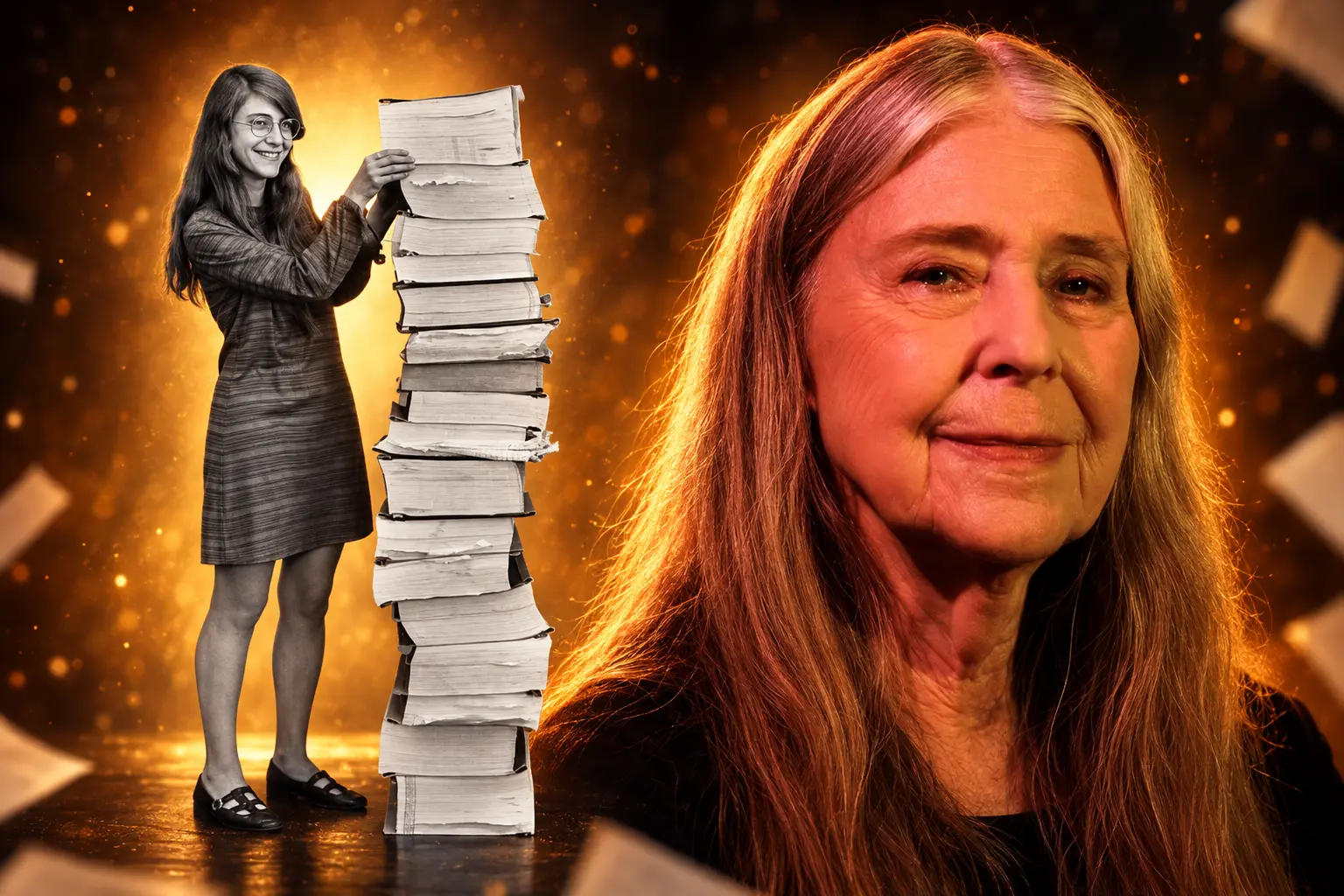
The tributes stop at a 1969 printout stacked taller than she was. After the moon she spent decades trying to keep the next overload from ever reaching a crew, and that half of the resume still sits offstage.
MIT Says She Died on Sept. 30
Olivier de Weck, the Apollo Program Professor and interim head of MIT’s Department of Aeronautics and Astronautics, said calling her a pioneer would be a dramatic understatement. She was writing and leading software, he said, when the field was still young, on a system as tangled as anything people had built.
THE RECORD SHE LEFT
- The span: She worked at MIT from 1959 until the mid-1970s, then ran two software firms of her own.
- The paper trail: MIT credited her with more than 130 publications.
- The lab: By 1968, as assistant director of the Command and Service Module software team, more than 400 people on Apollo software were on the job.
- The family: She is survived by Lauren Hamilton; her son-in-law, Richard Selesnick; two grandsons; four great-grandchildren; and siblings John, David, and Kathryn.
MIT hired her in 1965 after her husband spotted a newspaper ad for people to write software that would “send man to the moon.” The institute said she was the first programmer hired for the Apollo project there, and the first woman on that programming staff. Jerry M. Wohletz, president and CEO of Draper Laboratory, the independent lab that grew out of MIT’s Instrumentation Laboratory, said she left an indelible mark and that Draper would honor her legacy.
We’ve lost an icon. Margaret Hamilton, a computer science pioneer best known for her work at MIT leading development of the flight software for the Apollo missions to the moon, has died at 90. Read about her legacy via MIT News: https://t.co/ODkbdIsoHw pic.twitter.com/M2xauYYUkU
— Massachusetts Institute of Technology (MIT) (@MIT) October 7, 2026
Three Minutes of Alarms Over the Moon
In July 1969, as the lunar module Eagle dropped toward the Sea of Tranquility, the onboard computer threw a 1202 alarm. The machine was overloaded. A radar switch had been left on because of a faulty operations script, and the extra work was crowding out the jobs that had to fly the lander.
Hamilton’s group had already built priority-driven software that could drop lower-priority tasks, restart, and keep the landing work alive. Mission Control trusted that design and let the descent continue. Neil Armstrong and Buzz Aldrin walked on the moon.
President Barack Obama used that stretch of the flight when he put the Presidential Medal of Freedom on her in the East Room on Nov. 22, 2016.
Our astronauts didn’t have much time. But thankfully, they had Margaret Hamilton.
Barack Obama, President, White House East Room, Nov. 22, 2016
He added, in thankfully, they had Margaret Hamilton as part of a longer citation, that software engineering was not even a field yet and that there were no textbooks to follow. The line the White House printed for the medal itself said she had helped set the foundation for modern, ultra-reliable software design.
What Happened When Lauren Hit P01
The 1202 save is the story everyone knows. The earlier scare is the one that shows how she actually thought.
Lauren, then four, came to the Instrumentation Lab on nights and weekends and liked to play astronaut on the command-module simulator. One day she selected P01, the prelaunch program, while the simulated vehicle was already in flight. The session crashed. Navigation data vanished.
Hamilton wanted error-detection code that would refuse P01 in flight. MIT and NASA told her the astronauts were too well trained to make that mistake. She wrote a program note instead. During Apollo 8 in 1968, Jim Lovell did exactly what Lauren had done, and the onboard navigation data disappeared. Hamilton’s team had to rebuild and uplink it. After that, the software change went in.
She later called it the Lauren error. It is the cleanest picture of her method: assume a trained operator will still press the wrong key, then write the machine so the wrong key cannot wreck the mission.
Hardware Engineers Treated the Name as a Joke
Born Margaret Elaine Heafield in Paoli, Indiana, she earned a BA in mathematics, with a minor in philosophy, from Earlham College in 1958 and moved to Boston the next year while her husband started law school. A temporary MIT post under meteorology professor Edward N. Lorenz put her on weather-prediction software; MIT says that work later fed Lorenz’s papers on chaos theory.
In 1961 she went to MIT Lincoln Laboratory and wrote software for SAGE, the Air Force air-defense system, on the prototype AN/FSQ-7 (XD-1). When a program crashed, lights flashed and bells rang and the whole room came looking for whose code had hurt the machine. That is where she started caring about reliability as a subject, not a patch.
On Apollo she used a phrase the hardware staff found funny.
I fought to bring the software legitimacy so that it, and those building it, would be given its due respect, and thus I began to use the term software engineering to distinguish it from hardware and other kinds of engineering, yet treat each type of engineering as part of the overall systems engineering process. When I first started using this phrase, it was considered to be quite amusing. It was an ongoing joke for a long time.
Margaret Hamilton, in remarks later quoted by MIT
She told MIT News in 2009 that software had been a black box, that upper management had given the programmers freedom and trust, and that there had been no second chance. “Looking back, we were the luckiest people in the world; there was no choice but to be pioneers,” she said.
A Private Language for Keeping Bugs Out
The landing made her famous for recovery: asynchronous software, priority scheduling, priority displays, a human in the loop. Paul Curto, the NASA technologist who later nominated her for a Space Act Award, called those ideas the foundation for ultra-reliable software design. She treated that as unfinished business. Recovery is what you do after a fault is already inside the machine. She wanted the fault kept out.
When Apollo wound down she stayed with the Instrumentation Lab into the 1970s, through work that also covered Skylab, then left to build companies around prevention rather than late testing.
THE FIRMS AFTER APOLLO
| Company | Opened | What she said it was for |
|---|---|---|
| Higher Order Software | 1976 | Error prevention and fault tolerance, drawn from the Apollo lessons |
| Hamilton Technologies | 1986 | A language and tools meant to raise reliability, cut cost, and shorten delivery time |
Hamilton Technologies’ flagship was the Universal Systems Language, a modeling method whose slogan was Development Before the Fact. The Computer History Museum, which named her a 2017 Fellow, put her claim in plain language: instead of hunting for errors late, the majority of errors, including interface errors, are not allowed into a system by the way it is defined. That is the opposite of how most large software is still built, which is why the 1202 story travels and the language does not.
De Weck, summing up a career rather than a landing, said it had been dedicated to preventing errors and to what she called handling the unknown.
$37,200 and a Medal in the East Room
Public honors arrived long after the flights. NASA’s check was the blunt one.
THE HONORS CALENDAR
- Sept. 3, 2003: NASA grants the Exceptional Space Act Award and a check for $37,200, which the agency then called the largest award to an individual in its history, under a congressional cap of $100,000 per innovation.
- 2015: The Apollo software added to GitHub in full, the listings no longer trapped in a lab cabinet.
- Nov. 22, 2016: Obama awards the Presidential Medal of Freedom, with Grace Hopper honored posthumously in the same East Room class.
- 2017: The Computer History Museum names her a Fellow, and a Lego minifigure of her, from a set first designed by MIT science communicator Maia Weinstock, goes on sale worldwide.
- 2019: She receives the Intrepid Lifetime Achievement Award.
- 2022: Induction into the National Aviation Hall of Fame.
Sean O’Keefe, NASA administrator in 2003, said the Apollo flight software had been a pioneering effort and that the concepts her team created became building blocks for modern software engineering. Curto said he had been surprised to find she had never been formally recognized. The medal citation, 13 years later, still pointed at asynchronous software, priority scheduling, priority displays, and human-in-the-loop decisions, which is to say the Apollo toolkit, not the Universal Systems Language.
The Printout Photo Still Outruns the Language
A 1969 Instrumentation Laboratory publicity picture of Hamilton beside the stacked Colossus and Luminary listings is what people now share. MIT said the photo made her an icon for women in science once it spread online. The replies under the institute’s death notice still orbit that image. The later companies, the 001 tools, and the argument that most bugs should be illegal at design time barely surface.
WHAT THE TRIBUTES KEEP SKIPPING
- The SAGE drills: Reliability as a public, noisy failure in a room full of operators, years before the moon.
- The Lauren test: A child on a simulator as a better fault model than a perfectly trained astronaut.
- The second product: A language meant to make the 1202 class of rescue less necessary, which never became how the industry writes code.
Priority scheduling and restart protection did travel. They sit under flight systems, phones, and cars in forms she would recognize. The prevention language did not. She won the fight to have software treated as engineering in name. She did not win the fight to have most errors excluded by construction.
“We had to find a way and we did. Looking back, we were the luckiest people in the world; there was no choice but to be pioneers.” —Margaret Hamilton
Rest in peace, Margaret. Your trailblazing work leading the development of the on-board flight software for the Apollo… pic.twitter.com/VyiuWokYiW
— NASA History Office (@NASAhistory) October 8, 2026
On Oct. 8 the NASA History Office posted her old line about having to find a way, and finding it. The line still fits the landing. It also fits the quieter work she did for the rest of her life, which the landing photograph continues to hide.
Frequently Asked Questions
When Did Margaret Hamilton Die?
She died on Sept. 30, 2026, at 90, in a Cambridge, Massachusetts, hospital, and MIT announced the death on Oct. 7 without stating a cause. She had turned 90 on Aug. 17, 2026, 44 days earlier, having been born in Paoli, Indiana, on Aug. 17, 1936.
Did Margaret Hamilton Coin Software Engineering?
She said she began using the phrase so software would be treated like other kinds of engineering, and that hardware colleagues kidded her about it until one respected hardware engineer agreed in a meeting. There were no formal computer-science degree programs when she started; the Computer History Museum records her noting that programmers learned by hands-on training on machines such as the LGP-30 and PDP-1 in Lorenz’s lab.
What Did the P01 Note on Apollo 8 Say?
After Lauren crashed the simulator, and before NASA would accept a software lock, Hamilton put a line into the program notes that told crews not to select P01 during flight. Jim Lovell still selected it on Apollo 8, the navigation data vanished, and only then did the protective code go into the flown software.
What Is the Universal Systems Language?
USL is the systems-modeling language Hamilton developed at Hamilton Technologies, paired with an automated environment she called the 001 Tool Suite. The method tries to keep interface errors out of a system by the way the system is defined, rather than finding them in late tests, which is the step she argued the Apollo recoveries had never made unnecessary.

Margaret Hamilton Dies at 90 With Her Prevention Fight Unfinished

Texas Executes Jamaal Howard After Tennessee’s Failed Injection

The Next Kia Sportage Leaves Its Cheap Compact Formula

Alaska Airlines Builds the Costly Long-Haul Model It Undercut

OpenAI Agents Probe Census and Education Sites for Public Data

Alfalfa Sprouts Outbreak Follows 16 Months Without Reinspection

Instagram First Draft Pulls the Rough Cut In-House

Rene Haas Ties an AI Cancer Cure to Scarce Chips

Himalayan Glacial Flood Risk Outran Nepal’s Lake Maps

AI Influencer Labels Fail to Protect Body Image
-
 LIFESTYLE1 month ago
Alfalfa Sprouts Outbreak Follows 16 Months Without Reinspection
-
 NEWS1 month ago
Instagram First Draft Pulls the Rough Cut In-House
-
 NEWS1 month ago
Rene Haas Ties an AI Cancer Cure to Scarce Chips
-
 NEWS1 month ago
Himalayan Glacial Flood Risk Outran Nepal’s Lake Maps
-
 NEWS1 month ago
AI Influencer Labels Fail to Protect Body Image
-

 NEWS4 weeks ago
NSA Wants AI to Sift Intercepts It Cannot Finish
-

 NEWS4 weeks ago
As Kids Get Better at Faces, Angry Women Get Harder
-

 BUSINESS4 weeks ago
The H100 Rental Spike Nvidia Cited Has Already Faded