
NEWS
As Kids Get Better at Faces, Angry Women Get Harder
A Boys Town MEG study of 149 youth found kids named angry men fastest and angry women slowest, while higher anxiety weakened early brain responses to angry men.

Kids in a Boys Town MEG study named angry men’s gender fastest and angry women’s slowest. Higher anxiety then weakened early visual brain waves to those angry men, while angry women kept drawing extra work.
Hua Bai, Yasra Arif, and Tony W. Wilson, neuroscientists at Boys Town National Research Hospital in Nebraska, ran the sessions. Their open MEG study of 149 youth appeared in the June 2026 issue of Developmental Cognitive Neuroscience, after going online on April 8, 2026.
Angry Female Faces Drew the Slowest Button Presses
The children and teens were not asked to name the emotion. They sat in a scanner and pressed a button for male or female, while adult faces flashed angry, happy, or neutral looks. Emotion was supposed to be irrelevant. It still changed the clock.
Across the group, angry male faces produced the quickest gender calls. Angry female faces produced the slowest, about 44 milliseconds behind, and that gap held no matter the child’s age. Neutral faces showed an age pattern too. Happy faces did not.
Accuracy told a milder version of the same story. Male faces were easier to gender correctly, and accuracy on female faces climbed more steeply with age. The three-way mix of age, face gender, and expression that showed up in speed did not show up in accuracy.
MEAN GENDER-CALL TIMES
| Face | Mean RT (ms) | SD |
|---|---|---|
| Angry female | 880.71 | 165.52 |
| Angry male | 836.86 | 143.28 |
| Happy female | 859.48 | 147.05 |
| Happy male | 840.71 | 143.75 |
| Neutral female | 854.58 | 147.09 |
| Neutral male | 853.92 | 157.99 |
Bai and colleagues recruited 186 typically developing children and teens, ages 6 to 17, from the Omaha area (mean age 10.46 years, 102 male). After dropping 37 for poor task performance, MEG noise, or technical problems, 149 remained. That analyzed group had a mean age of 10.06 years and ranged from 6.02 to 15.29 years. Eighty were male.
Faces That Break the Script Draw Extra Brain Work
The brain data split into two speeds of activity. Alpha and beta waves (11 to 20 Hz) dropped in power from 150 to 750 milliseconds after each face, a pattern the team split into an early window (150 to 450 ms) and a late one (450 to 750 ms). Gamma waves (64 to 84 Hz) rose later, from 500 to 800 ms.
Those early alpha and beta changes grew stronger with age in visual cortex and in a motor-planning patch called the left pre-supplementary motor area. The extra work clustered on pairings that clash with the usual script: angry women and happy men. In lateral and inferior occipital cortex, age slopes were steeper for those mismatched faces than for the expected ones.
The pre-SMA kept that angry-male response going into the late window. Stronger alpha and beta activity there went with a smaller age-related speed-up on angry men. In plain terms, older kids still got faster, but the ones whose motor-planning tissue was working hardest did not speed up as much. The authors read that as inhibitory control, a brief brake on a threatening cue before the finger moves.
Gamma told a later story in social hubs: left supramarginal gyrus, temporoparietal junction, and superior temporal gyrus. Power there rose with age most clearly for angry female faces. The team argues those regions do the extra integration that a mismatched social signal needs, which is one reason the button press lagged. A test that gamma in the temporoparietal junction carried the age effect on angry-female speed did not survive a false-discovery correction, so they flagged it as exploratory.
Neutral faces did not settle on one gender. Some patches responded more to neutral men, others to neutral women. Bai’s group wrote that a blank expression is already ambiguous, so gender does not sort it cleanly.
Higher Anxiety Weakens the Response to Angry Men
Self-reported anxiety entered the models for the 107 youth old enough for the Behavioral Assessment System for Children, Third Edition, which starts at age 8. Their mean raw anxiety score was 11.24 (standard deviation 6.79; range 0 to 34). The scale was roughly normal, and the team used raw scores, not clinical cutoffs.
In left lateral occipital cortex, during the early alpha and beta window, anxiety changed the age path for angry faces. Kids with higher scores showed weaker responses to angry men as they got older. Responses to angry women stayed high across anxiety levels. A similar three-way pattern in the cerebellum for happy faces did not survive correction.
Youth with higher anxiety showed weaker alpha/beta oscillations to angry male faces, suggesting attentional suppression or avoidance of potentially threatening cues, while responses to angry female faces increased consistently across anxiety levels.
Hua Bai and colleagues, Developmental Cognitive Neuroscience
That split matches a long-running clinical idea, the hypervigilance-avoidance pattern: anxious people lock onto threat, then pull attention away to cut distress. Here the pull-away is selective. The culturally expected threat, an angry man, is the one that gets turned down. The mismatched threat, an angry woman, does not.
The sample was typically developing. No one in it carried a diagnosed anxiety disorder, so the finding is about everyday symptom scores, not clinic cases. The authors still treat it as a possible fork in development, a way early sensory gating could drift off the usual path.
Why People Imagine Anger on a Male Face
Ask someone to picture an angry face and the face is usually male. Picture a happy face and it is usually female. D. Vaughn Becker and colleagues documented that pairing across seven experiments in 2007, with faster and more accurate detection of anger on men and happiness on women. Peter Kay Chai Tay later framed the same pairing as an angry-male happy-female processing advantage, arguing that angry men signal physical threat and happy women signal care.
Two mechanisms sit under that pattern, and they are easy to mash together. One is learning. Boys are granted more anger; girls are steered toward smiles. The other is bone and muscle. Male faces, even at rest, share features with a scowl (heavier brow, squarer jaw). Female faces share features with a smile. Anger on a woman can make her look more male, which is a problem if the task is to say which gender she is.
Daniel Fitousi, a psychologist at Ariel University, later used formal tests of dimensional independence and found perceptual and decisional face biases both at work. The Omaha kids were doing a gender task, so both routes could slow an angry woman: the face looks less female, and the pairing feels wrong. Bai’s paper leans on the cultural script, citing work that children learn anger-as-male and happiness-as-female and then spend more attention when a face breaks the pairing.
A 2022 museum study of 394 children, led by researchers who measured happy-angry morphs, found that an explicit angry-male/happy-female judgment bias actually eased with age. That result does not cancel the MEG finding. Judging emotion out loud is a different job from leaking emotion into a gender button. The Omaha data say the brain still spends extra current on the mismatch, even if a spoken label gets fairer.
What the Omaha MEG Session Looked Like
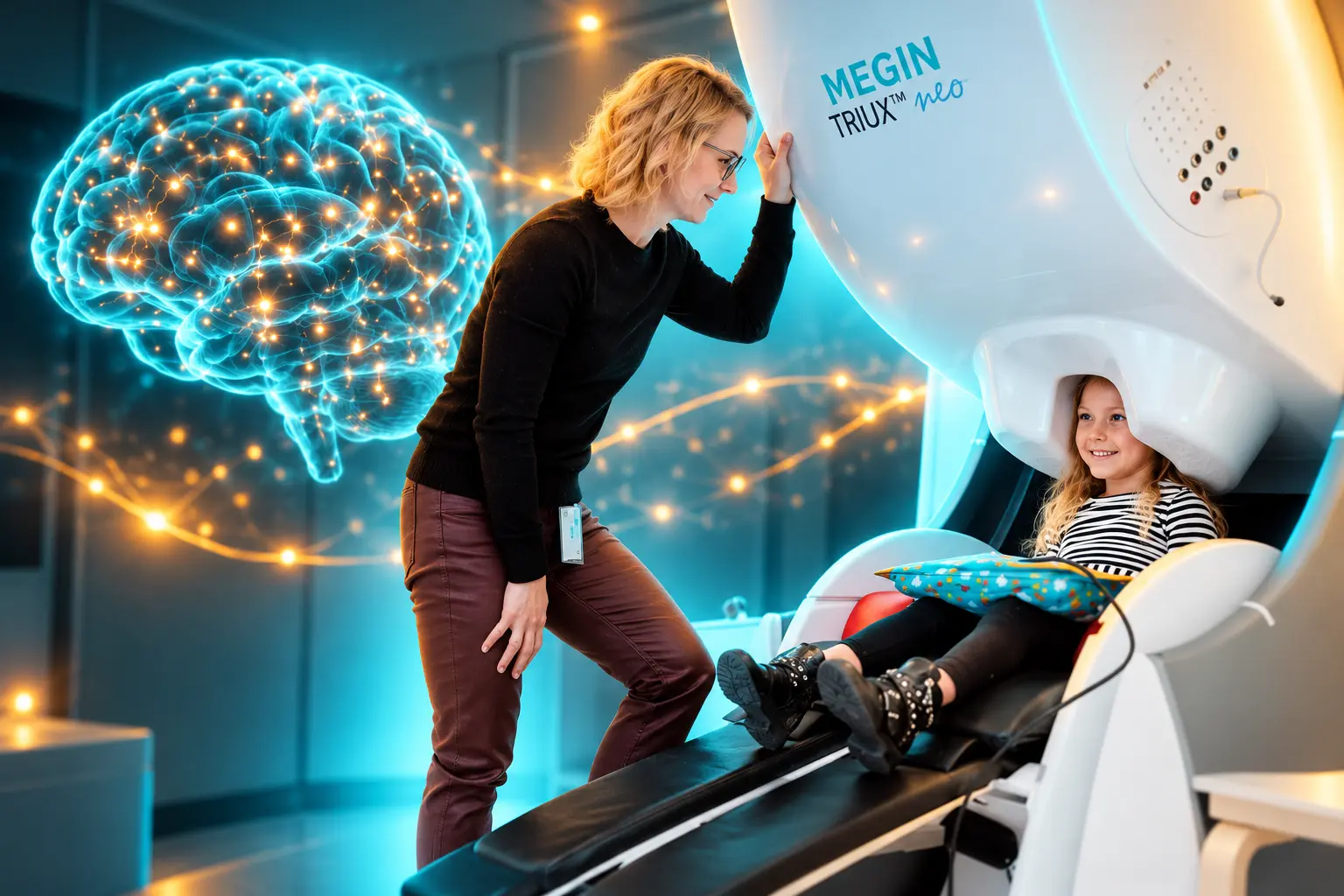
The Institute for Human Neuroscience sits on the Boys Town campus and houses two next-generation MEG systems, a claim the hospital repeats as unique worldwide. MEG picks up the faint magnetic fields that firing neurons produce, with millisecond timing that fMRI cannot match. Wilson, the institute’s director and the paper’s senior author, led the work as part of the NIH-funded Dev-MIND multimodal imaging project (R01-MH121101), with added support from P20-GM144641, F30-MH134713, and S10-OD028751.
Faces came from the RADIATE set built by May I. Conley and colleagues: 40 adult actors, ages 18 to 30, balanced by sex and by White, Black, Hispanic, and Asian identity. Each child saw 240 trials, 40 in each of six cells (male or female crossed with angry, happy, or neutral). A fixation cross lasted about 1.6 seconds. Each face stayed up for 1.5 seconds. The run took about 13 minutes.
THE MEG GENDER TASK
- Scanner: A 306-sensor MEGIN Neo system in a two-layer magnetically shielded room; analyses used the 204 planar gradiometers.
- Job: Press male or female on every trial, ignoring the expression.
- Kept trials: After artifact cuts, a mean of 220.96 trials per child (minimum 171) entered the maps.
- Anxiety form: BASC-3 self-report anxiety subscale, 4-point items from never to almost always, only for ages 8 and up.
The team covaried out trial count so older kids’ cleaner data would not fake a developmental effect. A sensitivity check without that covariate left the same cortical patches standing. An early cut of the work was given at the 2025 meeting of the Association for Psychological Science.
Adult Faces, a White Sample, and One Snapshot
The limits are not fine print. They change what a parent or teacher can take from the maps.
WHAT THE STUDY CANNOT SAY
- Clinic cases: Only typically developing youth were enrolled. Kids with social anxiety disorder or autism were out, along with anyone with a neurological or psychiatric diagnosis, head trauma, or current substance use.
- Peer faces: Every photograph was an adult. The authors note that future work should add child and teen faces, citing prior evidence that adolescents shift toward peer faces.
- Who sat in the chair: In the final 149, 123 identified as White, 20 as more than one race, 4 as Black, 1 as Asian, and 1 did not report; 7 were Hispanic. The faces were racially mixed. The viewers were not.
- Time: One visit per child. The paper cannot say whether a 7-year-old’s pattern becomes a 15-year-old’s pattern in the same brain.
- Deep threat circuitry: Gradiometers and beamforming are weaker for amygdala and other deep sources, so the maps are a cortical story.
Bai’s group also did not measure parenting, culture, or income, all of which could shape the gender-emotion script they treat as background. They point to possible uses in early anxiety care, but they do not test a treatment.
The irony in the data is already concrete. Getting older did not make every face easier in the same way. It made the expected threat, an angry man, a faster gender call, and it made an angry woman the slowest. Anxiety then turned down the volume on the expected threat and left the mismatched one loud. The recordings will go into the COINS archive when Dev-MIND finishes. Until someone tracks the same children year after year, and shows them faces their own age, that is the map we have.
Frequently Asked Questions
What Is Magnetoencephalography in a Child Face Study?
MEG records the magnetic fields that electric activity in neurons produces, using helmet sensors rather than injected tracers or a loud MRI tunnel. In this study the MEGIN Neo system sampled at 1 kHz with a 0.1 to 330 Hz bandwidth, and only gradiometer channels went into the maps, a choice that favors cortical sources and cancels some noise. That timing is why the team could separate an early alpha/beta window starting at 150 milliseconds from a gamma burst that did not peak until 500 to 800 milliseconds.
Why Did the Kids Judge Gender Instead of Emotion?
An implicit gender task keeps emotion off the instructions, so any emotion effect is a leak, not a labeled judgment. The design also matches the adult literature on how anger and happiness collide with sex classification. Because anger shares features with a male face, an angry woman can scramble the very decision the child is trying to make, which is a separate cost from finding her expression socially surprising.
Did the Study Include Children With Anxiety Disorders?
No. Exclusion rules barred neurological or psychiatric disorders, so the anxiety result is about self-report scores in a community sample, not a clinic diagnosis. The BASC-3 anxiety mean of 11.24 on a raw scale that ran from 0 to 34 sat in a roughly normal distribution (skewness 0.59), which is why the authors talk about higher and lower scores rather than patients versus controls.
What Does a BASC-3 Anxiety Score Measure?
Cecil R. Reynolds and Randy W. Kamphaus built the Behavioral Assessment System for Children, Third Edition, as a broad rating battery; this paper used only the self-report anxiety subscale for ages 8 and older. Items are scored 0 (never), 1 (sometimes), 2 (often), or 3 (almost always), and the authors cite internal consistency of 0.92 to 0.97 and test-retest correlations of 0.87 to 0.94 from the test manual. They entered raw totals, not T scores, into the brain models.
What Face Photographs Did the Children See?
All 40 actors came from the racially diverse affective expression set, an open library of 1,721 color and black-and-white expressions from Black, White, Hispanic, and Asian adult models, described in 2018 by May I. Conley, Nim Tottenham, B.J. Casey, and colleagues. Each actor was 18 to 30 years old. The set was built to fix the old habit of testing social brains on almost entirely White faces, even though the Omaha viewer sample itself remained predominantly White.
Disclaimer: This article is news reporting on a published neuroimaging study of typically developing children and is for information only. It is not medical, diagnostic, or mental-health advice and should not be used to assess a child’s anxiety, to interpret a brain scan, or to change treatment. Parents and caregivers who are worried about a child’s fear, avoidance, or social stress should speak with a qualified pediatrician, child psychologist, or child psychiatrist before acting on any finding described here. Sample sizes, reaction times, brain-wave results, and anxiety scores reflect the paper and its cited instruments as they stood in the April 2026 publication and may be revised if the authors or later studies update the record.

Margaret Hamilton Dies at 90 With Her Prevention Fight Unfinished

Texas Executes Jamaal Howard After Tennessee’s Failed Injection

The Next Kia Sportage Leaves Its Cheap Compact Formula

Alaska Airlines Builds the Costly Long-Haul Model It Undercut

OpenAI Agents Probe Census and Education Sites for Public Data

Alfalfa Sprouts Outbreak Follows 16 Months Without Reinspection

Instagram First Draft Pulls the Rough Cut In-House

Rene Haas Ties an AI Cancer Cure to Scarce Chips

Himalayan Glacial Flood Risk Outran Nepal’s Lake Maps

AI Influencer Labels Fail to Protect Body Image
-
 LIFESTYLE2 months ago
Alfalfa Sprouts Outbreak Follows 16 Months Without Reinspection
-
 NEWS2 months ago
Instagram First Draft Pulls the Rough Cut In-House
-
 NEWS1 month ago
Rene Haas Ties an AI Cancer Cure to Scarce Chips
-
 NEWS1 month ago
Himalayan Glacial Flood Risk Outran Nepal’s Lake Maps
-
 NEWS1 month ago
AI Influencer Labels Fail to Protect Body Image
-

 NEWS1 month ago
NSA Wants AI to Sift Intercepts It Cannot Finish
-
 BUSINESS1 month ago
The H100 Rental Spike Nvidia Cited Has Already Faded
-

 NEWS1 month ago
LinkedIn Finds Gen Z Too Afraid to Use Its Network