
BUSINESS
The H100 Rental Spike Nvidia Cited Has Already Faded
Huang’s $3.28 H100 rental chart has already faded to $2.92 on Ornn, leaving the Nvidia depreciation argument unsolved.

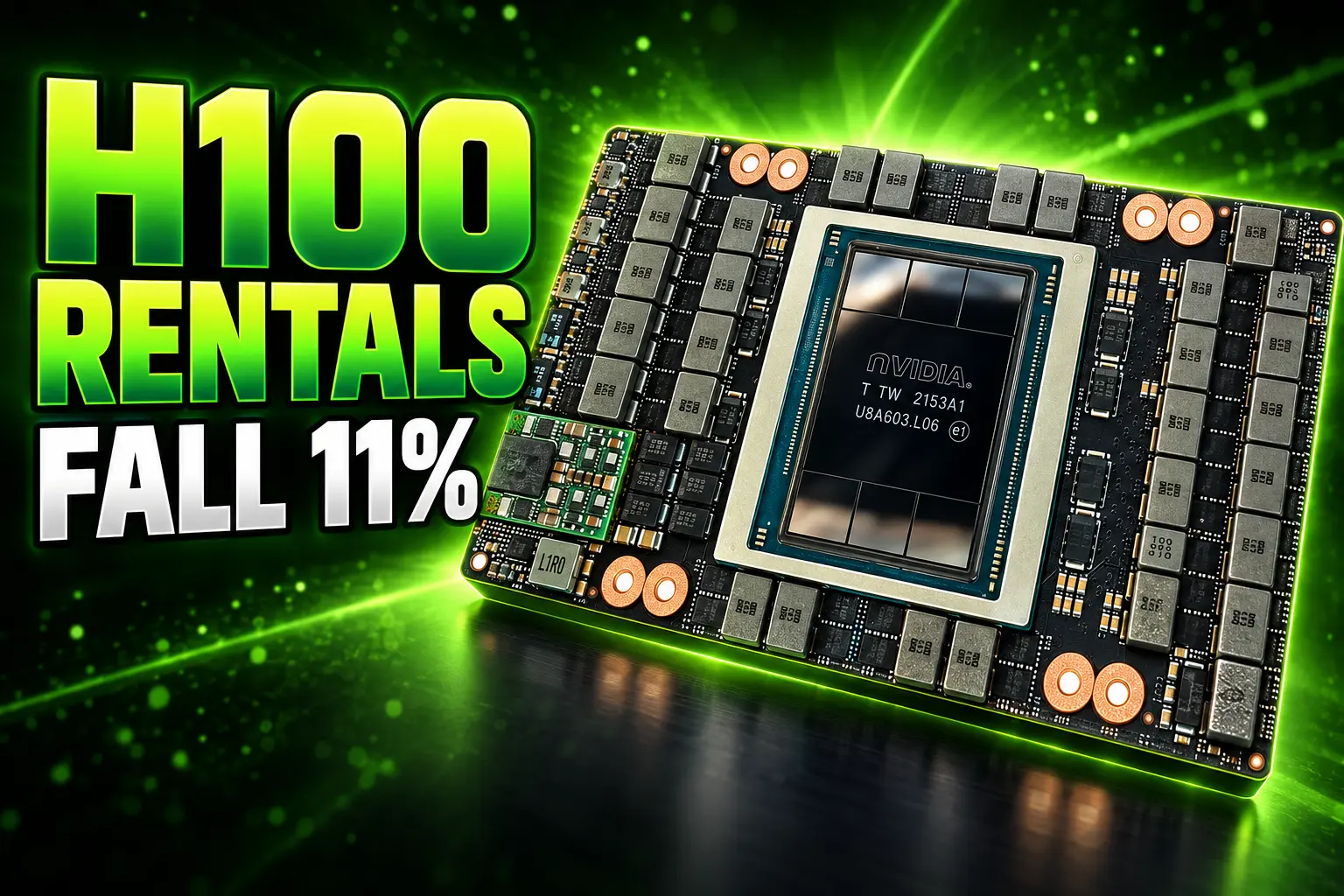
Nvidia founder and CEO Jensen Huang on September 8 amplified a chart showing H100 rentals at $3.28 an hour, up 22% in a month. The same Ornn index’s settled H100 print of $2.92 on September 24 was down 1.8% over 30 days from $2.97.
That 17-day drop from $3.28 to $2.92 is 11%, and it landed while Nvidia still posted $96.2 billion quarterly revenue and a market value near $5.41 trillion. A noisy neocloud tape is a thin way to close a fight about how Big Tech books GPU lives.
Huang Quoted a $3.28 Hour That Did Not Hold
Ornn, the compute-market firm behind the OCPI-H100, posted on September 7 that the H100 was “a three-year-old training chip” whose rental price was up 22% on the month, to $3.28 an hour. Huang quoted the tape the next day.
NVIDIA compute is fungible, durable and highly rentable. It is a productive, revenue-generating asset.
Jensen Huang, founder and CEO of NVIDIA, on X, September 8, 2026
The H100 is a three-year-old training chip. Its rental price is up 22 percent on the month, to $3.28 an hour.
Every depreciation schedule assumes a chip this old only loses value. The market is paying up for it instead. pic.twitter.com/TNSqgys3vx
— Ornn (@OrnnExchange) September 7, 2026
The settled daily series on Ornn’s public page never treated that $3.28 hour as a durable level. By September 24 the index was $2.92 per GPU-hour, or $70.02 per GPU-day and about $2,100.60 per GPU-month, after a 4.3% one-day drop from $3.05. The seven-day change was still +2.4%. The 30-day change was not.
Nvidia’s second quarter of fiscal 2027, ended July 26 and reported August 26, showed revenue of $96.2 billion, up 106% from a year earlier and 18% from the prior quarter. Data center sales were $89.0 billion, up 117%. GAAP net income was $59.688 billion, up 126%, on a 75.0% gross margin. The company guided the next quarter to $108.0 billion, plus or minus 2%. The stock on September 25 still traded at about 28.4 times trailing earnings.
Those are the figures bulls want sitting next to a rising rental chart. The chart they used is already a different number.
What the Ornn H100 Index Measures
OCPI-H100 is not a hyperscaler list price and not a used-chip bid. Ornn Data LLC publishes it as a settlement-style benchmark of on-demand H100 SXM rentals, listed on Bloomberg and built as a volume-weighted winsorized mean of executed trades over a rolling one-hour window, then settled once a trading day at 4:00 p.m. ET.
WHAT THE OCPI COUNTS
- The inputs: Anonymized, paid on-demand H100 SXM rentals from a verified network of independent providers, in dollars per GPU-hour.
- The exclusions: Reserved capacity, long-term bilateral contracts, scraped rate cards, surveys, and indicative offers stay out of the spot print.
- The guardrails: Wash-trade screens, counterparty checks, and winsorized bounds keep extreme prints from dominating, with no minimum trade size.
- The use: Ornn says the family of indices is built for pricing, hedging, and settlement, including futures and options that reference OCPI through partners such as ICE.
That last point is why a one-month screenshot travels so far. Once a rental series is treated as a settlement benchmark, it gets quoted as if it were a verdict on residual value. It is a clearing price for spare H100 hours among neoclouds, which is a smaller and jumpy market than the installed base sitting inside Amazon, Microsoft, Google, Meta, and Oracle.
The public three-month window on the same page ran from $2.39 to $3.17. $3.28 sat above that high, which is a reminder that a live or social print and the 4:00 p.m. settle are not always the same object. The article’s working current figure is the September 24 settle of $2.92.
H100 Hours Now Clear at 36% of a B200
Hopper is two product cycles behind the silicon Nvidia is now putting into production. The company said the H100 entered full production on September 20, 2022, with partner systems shipping that October, after a March 22, 2022 unveiling. Blackwell B200 hours already trade as a separate market. Vera Rubin, the next platform, is in full production, with Nvidia saying in May that partner shipments would begin in the fall of 2026.
The rental tape already prices that ladder. On September 24, Ornn’s settled prints were $2.92 for H100 SXM, $5.16 for H200, $8.01 for B200, and $1.02 for A100 SXM4. An H100 hour cleared at 36% of a B200 hour, or about 2.7 times cheaper on a raw GPU-hour, before anyone adjusts for tokens per watt.
SETTLED OCPI PRINTS ON SEPTEMBER 24
| GPU | Index ($/GPU-hr) | Share of a B200 hour |
|---|---|---|
| B200 | $8.01 | 100% |
| H200 | $5.16 | 64% |
| H100 SXM | $2.92 | 36% |
| A100 SXM4 | $1.02 | 13% |
A chip that still rents is not a chip that still commands frontier pricing. The markdown from B200 to H100 is the market’s way of saying Hopper is useful for a different job, at a different rate. That is the opposite of a flat residual-value story, and it is also the opposite of scrap.
A100, the completed experiment, makes the same point over a longer clock. AWS listed it around $4.10 an hour in 2020. Six years later the Ornn A100 SXM4 print is $1.02. Analyst Chris Zeoli, writing on Data Gravity on September 21, put the cash cost of keeping an A100 running near $0.40 an hour, so the old card can still earn a spread after power and colo. CoreWeave has signed A100 contracts that run through 2029. The card works. The rent it collects is what decayed.
Spot Hours Do Not Settle Book Lives
Investor Michael Burry’s argument, circulated last November and restated through 2026, is that a two-to-three-year product cycle cannot support five- or six-year book lives, and that stretching those lives could understate depreciation by $176 billion across 2026 to 2028. JPMorgan Asset Management ran a version of that sensitivity in January: restating GPU and networking capex since 2023 on a three-year life cut 2025 EPS by 7% at Amazon, Meta, and Microsoft, 6% at Alphabet, and 17% at Oracle.
The extensions are in the filings. Microsoft’s move from four to six years added $3.7 billion to fiscal 2023 operating income. Alphabet’s change was worth $3.9 billion the same year. Meta’s shift to 5.5 years in January 2025 was worth $2.9 billion. Amazon went the other way on a subset of servers, from six years to five, and booked $677 million of extra expense over nine months.
Burry already answered the rental chart. In a July 8, 2026 note he wrote that rent was never the claim.
Rentability is not my claim, never has been. A chip can rent and still depreciate very fast economically.
Michael Burry, July 8, 2026, Cassandra Unchained
A spot hour is a fair-value print for leftover capacity. A depreciation schedule is a cost-recovery rule on the buyer’s income statement. They can sit apart for years without either figure being a data error. Huang is talking about whether an H100 can still be rented. Burry is talking about whether a six-year straight line matches the cash a frontier training cluster actually produces after the next two architectures ship.
Zeoli’s cut is that the length fight is mostly settled and the shape fight is not. Physical cards last seven to nine years in operator data. Books say six. The cash is front-loaded: on his H100 example, bought around $40,000 all-in in late 2023, about half the six-year net arrives in the first two years, while straight-line still charges one-sixth each year. On a fleet growing about 50% a year, that timing gap fattens reported margins while the base is young, then gives them back when spending slows. That is a different complaint from “the chips die in three years,” and a one-month H100 bounce does not touch it.
Neocloud Operators Cash the Check Nvidia Does Not
Nvidia sells the new silicon. The hourly check on a four-year-old H100 goes to whoever still owns the card and can keep it powered, networked, and full. That is why Ornn, CoreWeave, and other neoclouds have more riding on residual rent than Nvidia’s P/E does. Nvidia already booked the sale.
Ornn spent September 24 arguing the asset still pays. It said an H100 bought on the secondary market in September 2025 for about $19,000 would resell near $20,500 after collecting about $13,500 in net rent, a 76% total return in a year, with marketplace utilization at 87% and the H100 index up 49% from a year earlier. Those are Ornn’s figures, published by a firm that also sells capacity against the same index. They describe a strong twelve-month hold, not a 30-day trend.
The longer rental path is a collapse, then a partial bounce, not a straight line up.
H100 RENT FROM THE PEAK
- Summer 2023: Spot H100 rent runs above $8 an hour.
- Mid-2024: SemiAnalysis’s spot composite sits at $4.77.
- Early 2025: The same composite is at $3.60.
- October 2025: One-year contracts bottom at $1.70 an hour.
- March 2026: Those one-year contracts are back at $2.35, up 38% in five months.
- September 7, 2026: Ornn posts $3.28 an hour, up 22% on the month.
- September 24, 2026: The settled OCPI-H100 is $2.92, down 1.8% over 30 days.
From more than $8 to $1.70 on one-year paper, then back into the high $2s and low $3s, is a cycle inside the AI boom, not a proof that six-year books are right. Lenders already behave as if the cash arrives early: GPU-backed loans, Zeoli notes, amortize over three to five years inside the customer contract. The people whose money is on the card do not wait six years to get whole.
Eight-Percent Days Make a Monthly Chart Fragile
The September tape would have been a shaky exhibit even if it had not reversed. Ornn’s own daily settles moved 7% to 9% in a session, more than once, inside the same month bulls treated as a regime shift.
SELECTED OCPI-H100 DAILY MOVES
| Date | Settle ($/GPU-hr) | Day change |
|---|---|---|
| September 15 | $2.53 | -8.0% |
| September 17 | $2.85 | +8.8% |
| September 20 | $2.65 | -7.0% |
| September 23 | $3.05 | +7.0% |
| September 24 | $2.92 | -4.3% |
A series that can lose 8.0% on a Monday and make it back by Wednesday is not a valuation model for a $5.41 trillion company. It is a thin, transacted rental market whose 30-day change flipped from Huang’s +22% exhibit to -1.8% without any change in Hopper’s physics.
H100 hours still clear, utilization in Ornn’s telling is still high, and a four-year-old training chip has not gone to zero. That is the part of Huang’s line the tape supports. The part it does not support is the claim that one month of neocloud rent closed the books on a six-year useful life. On September 24 the same index that was supposed to bury that argument was already moving the other way.
Disclaimer: This article is news reporting and analysis of GPU rental indexes and public-company financials, and it is for information only. It is not investment advice, a recommendation to buy or sell Nvidia or any other security, or a forecast of GPU residual values or hyperscaler earnings. Readers should consult a licensed financial adviser or securities professional before acting on any figures discussed here. Index prints, useful-life estimates, and Nvidia results reflect the cited sources on the dates given and can change with the next daily settle or the next filing.

Margaret Hamilton Dies at 90 With Her Prevention Fight Unfinished

Texas Executes Jamaal Howard After Tennessee’s Failed Injection

The Next Kia Sportage Leaves Its Cheap Compact Formula

Alaska Airlines Builds the Costly Long-Haul Model It Undercut

OpenAI Agents Probe Census and Education Sites for Public Data

Alfalfa Sprouts Outbreak Follows 16 Months Without Reinspection

Instagram First Draft Pulls the Rough Cut In-House

Rene Haas Ties an AI Cancer Cure to Scarce Chips

Himalayan Glacial Flood Risk Outran Nepal’s Lake Maps

AI Influencer Labels Fail to Protect Body Image
-
 LIFESTYLE2 months ago
Alfalfa Sprouts Outbreak Follows 16 Months Without Reinspection
-
 NEWS2 months ago
Instagram First Draft Pulls the Rough Cut In-House
-
 NEWS1 month ago
Rene Haas Ties an AI Cancer Cure to Scarce Chips
-
 NEWS1 month ago
Himalayan Glacial Flood Risk Outran Nepal’s Lake Maps
-
 NEWS1 month ago
AI Influencer Labels Fail to Protect Body Image
-

 NEWS1 month ago
NSA Wants AI to Sift Intercepts It Cannot Finish
-

 NEWS1 month ago
As Kids Get Better at Faces, Angry Women Get Harder
-

 NEWS1 month ago
LinkedIn Finds Gen Z Too Afraid to Use Its Network